Below
is an account by a local farmers son, written soon after the wreck. THE
WRECK OF THE "CIRILO AMOROS". Personal
Recollections. On
the morning of Feb. 15th 1925 I was awakened by an excited shout from my father:-
get up quick. There's a ship ashore in Ballyvooney. I was not quite ten years
old at the time. I
jumped out of bed, dressed quickly and mounted the fence that then bounded the
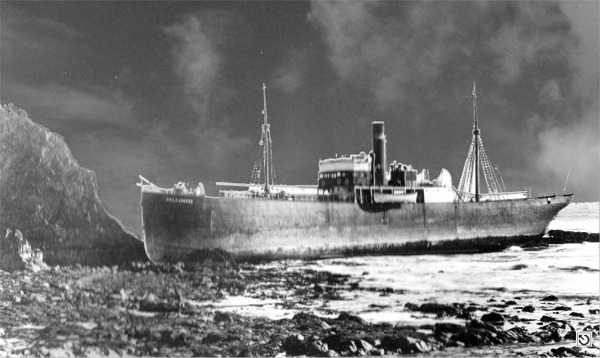
yard. From there I could see a steamship standing upright with her bow to the
cliff at the point known as the Arch. Nicky Hickey who worked in Knockrour, then
arrived. Ship or no ship, certain work had to be done so Nicky and my mother started
the milking. I shot down to Ballyvooney. My
father had gone ahead and had made signs to the captain to launch one of the life
boats but the captain replied through a megaphone that a boat would be smashed
against the ship side and indicated that he intended throwing out a lifebuoy to
which a line was attached. This he did and the buoy floated towards the shore.
My father waded out and retrieved it - not without difficulty as there was a strong
undertow on the shelving gravely bottom and only by bracing his feet against a
low rock was he able to maintain himself. I
arrived at this stage and saw the ship was named "Cirilo Amoros" which
we later discovered meant 'The Loving Girl'. She flew two flags which I
later learned were the Spanish National colours and the international distress
signal. We also learned afterwards that she was owned by the Transmediterranean
Co. of Barcelona and on her way to Liverpool with general cargo. Jack
O'Keefe was on his way to work in Ballyvooney and returned to Stradbally to notify
the Guards. My father dispatched me to alert Ballyvooney and gather help. Jim
Power was milking but left the finishing of the Job to Bridgie and rushed down.
I notified the other families - Tommy Halley, Jim Cummins, the Norrisses and Christophers.
When I got back to the cove the line had been followed by a heavier cable which
was hauled to the cliff-top and made fast to the fencing stakes. A breeches buoy
was rigged up and a sailor came ashore using a lump of tallow to grease the cable
as he came. The
rest of the crew followed, and then hampers made of wire netting containing supplies
and the sailors' effects were hauled up. The rescued mariners were understandably
emotional after their harrowing experience. They had been drifting before a buffeting
storm and grounded on what must have appeared a terrifyingly bleak and inhospitable
coast. From where they were they would have seen no sign of human habitation except
for the lighthouses on Hook and Mine heads. Flagons
of wine were opened and fruit and cigarettes passed round. So freely did the locals
partake that one had to be conveyed home stretched out on a donkey cart. He was
unaware that during the excitement his wife had given birth to a daughter. A day
to remember! At
low tide it could be seen that the ship was firmly wedged between the cliff and
a rock. To this fact the crew owed their lives: but how she came to arrive in
that particular position has never been established. After
the rescue had been completed a rocket team from Bonmahon and the Helvick life
boat arrived but their services were not required. The crew were accommodated
in the local pubs and in private houses. During their stay fiesta reigned with
music Spanish dancing and free wine nightly. Only one member of the local community
was able to communicate in the sailor's native tongue. He was a sailor who had
learned Spanish in South America. The
cargo consisting of oranges, onions, tinned tomatoes, almonds, ground nuts, rice,
resin, and wine was bought from the insurers by Messrs. Shipsey and Mekee of Dunmore
East. It was slung ashore on a wire cable strung from the mast and anchored inland.
It was drawn to the village by horse and cart, an activity which provided handy
money for local farmers and which they eagerly awaited. Damaged cases of oranges
and onions were dumped overboard and during the following summer beaches within
miles of Ballyvooney had their first taste of pollution. The rice cargo was unfit
for human consumption due to flooding in the hold but made excellent pigfeed.
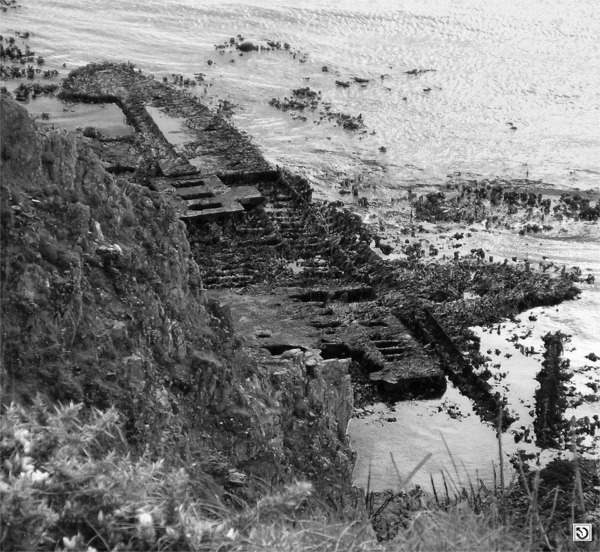
The bunker coal and the woodwork were sold to local buyers. And the hull to Eastwoods
of Belfast who gave us the, then extraordinary, sight of oxy-acetylene torches
cutting through half inch steel plate as if it had been butter. A
court of inquiry into the loss of the ship was subsequently held by the Dept.
of Industry & Commerce in Dublin but I am not aware of its findings. Though still
known as 'The Spanish Ship' she was in fact Scottish having been built
in Greenock on the Clyde. W.
O'Brien | 
 ©
©